
The 4% Rule for Retirement Income: Why Staying Invested Makes Your Money Last
Most people worry about running out of money in retirement. It’s one of the most common fears — and the instinct is almost always the same: move the money somewhere “safe.” The bank. A money market. Something that won’t lose value.
That instinct is the single biggest threat to your retirement.
The Retirement Math Behind the 4% Rule
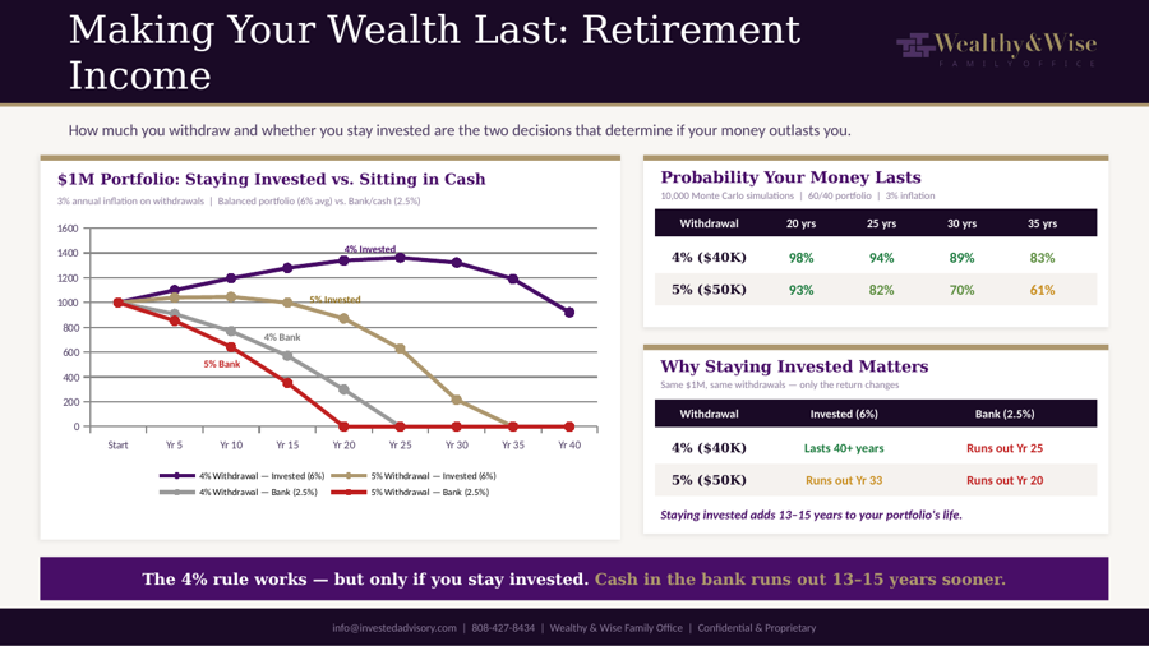
Take a simple scenario: $1 million at retirement, withdrawing 4% annually (adjusted for inflation each year thereafter). Stay invested in a balanced portfolio averaging 6% returns, and your money lasts 40+ years. Sit in cash or a bank account earning 2.5%, and your money is gone by year 25.
Same nest egg. Same withdrawals — starting at $40,000 a year. The only difference is whether your money is working or just sitting there, waiting to be spent down.
*** Illustrative: a $1M nest egg with 4% inflation-adjusted withdrawals — staying invested vs. sitting in cash.
The Probability Your Money Lasts
*** Probability of money lasting — 10,000 Monte Carlo simulations, 60/40 portfolio, 3% inflation (illustrative).

At a 4% withdrawal rate, staying invested in a balanced 60/40 portfolio gives you an 89% chance of your money lasting 30 years. Sitting in cash? Zero percent. Not low — zero.
This is why pulling out of the market during a crisis — or moving to cash “just until things calm down” — isn’t cautious. It’s the riskiest thing you can do with your retirement. Staying invested can add 15+ years to your portfolio’s life. The 4% rule works — but only if you stay invested.
What to Do (and What Not to Do)
Time and again, investors who sold during major crises — market crashes, recessions, pandemics, and geopolitical shocks — locked in losses while the recoveries happened without them. Nearly every time.
There’s a longer lens worth adding: it’s not just about surviving the next crisis. It’s about making sure your wealth outlasts you. And the data is overwhelming — the only way to do that with high confidence is to stay invested. Not in a money market. Not in a savings account. In a diversified, goals-aligned portfolio that compounds through every crisis, recovery, and boring Tuesday in between.
- Keep 3–6 months of expenses in cash. That’s your buffer — so you never have to sell investments at the wrong time.
- Don’t move your retirement portfolio to cash. The data is clear: cash in the bank can run out 15 years sooner than a balanced portfolio. “Safe” is the most dangerous word in retirement planning. When you retire, you won’t need all the money right away — and you may be in retirement for decades.
- If you have capital on the sidelines, it’s worth a conversation. Not to act impulsively, but to think clearly about whether your long-term plan matches the math — and whether “safe” means what you think it means.
“Safe” doesn’t mean low, fixed returns that can’t keep up with inflation. It means making sure your money outlasts you and provides for a long, comfortable retirement.
The Bottom Line
Markets have survived two World Wars, the Cold War, 9/11, the 2008 financial crisis, a global pandemic, and countless geopolitical conflicts. The worst 30-year period in U.S. history still returned roughly 8% per year. And the difference between staying invested and sitting in cash over a retirement horizon isn’t a few percentage points — it’s whether your money lasts or it doesn’t.
Panic has never been the right call. It isn’t now, either.
Want to talk it through? If you’d like to review how the 4% rule applies to your specific situation, reach out to a qualified advisor to build a plan matched to your goals and timeline.

Want to talk it through? If you’d like to review how the 4% rule applies to your specific situation, reach out to a qualified advisor to build a plan matched to your goals and timeline.

