
Investing 201: Beyond the Basics
Once the fundamentals are in place, the next layer is structure and self-knowledge: a written policy, an evidence-based strategy, tax awareness, and a clear-eyed look at your own biases.
The Investment Policy Statement (IPS)
An Investment Policy Statement is a written, custom document — typically between an advisor and a client — that sets out risk and return expectations before a single dollar is invested. A good IPS captures:
• The client's goals and objectives, risk tolerance, and time horizon
• The strategy and asset classes to be used — and any to be avoided, along with other client restrictions
• The duties and responsibilities of both advisor and client
• When reviews happen, and what triggers changes
A well-written IPS is a roadmap. Its real value shows up in bad markets: it keeps the focus on long-term goals and takes short-term emotional swings out of the decision process.
The Efficient Market Hypothesis — and why we index
The Efficient Market Hypothesis (EMH) proposes that markets incorporate all existing information and adjust quickly as new information arrives — which makes consistently beating the market extremely hard. The evidence backs it up: long-running scorecard research has found that the overwhelming majority of active fund managers fail to beat their index over time, that identifying the few winners in advance is effectively impossible, and that even past winners tend to underperform within a few years. The practical corollary: the only reliable way to expect more return is to take more risk. This evidence is the foundation of an index-based investment approach.
Core-satellite portfolios
Indexing the whole portfolio is a sound default, but a core-satellite structure can have a place for some investors. The idea: keep the core — the large majority of the portfolio — diversified and indexed, and allow small satellites for focused ideas or individual holdings you believe in or want to support (a values-based theme, company stock, a sector conviction). Keep the satellites to no more than roughly 10–20% of the total. Beyond flexibility, there is a behavioral benefit: the satellite “scratches the itch” without putting the core plan at risk.
Alternative assets and crypto
Alternatives —private investments, real estate, venture capital, and more recently digital assets — generally belong, if anywhere, in the satellite portion. They carry higher risk with higher potential, and most demand either hands-on effort (real estate) or genuine expertise (venture and private deals). On crypto specifically: the asset class is likely here to stay, but get educated first —understand the specific project and its use case — and only commit money you can genuinely afford to lose.
Taxes and your investments
Every investment lives in one of three tax “buckets”: tax-deductible (traditional 401(k)s and IRAs), tax-free (Roth accounts), or taxable. Maximize the tax-advantaged buckets first, then move down the ladder. Within taxable accounts, the timing of sales matters enormously:
• Short-term gains (assets held under one year) are taxed like ordinary income
• Long-term gains are taxed at reduced rates — and can even be taxed at 0% for households below certain taxable-income thresholds (confirm current IRS thresholds)
• Tax-loss harvesting — realizing losses to offset gains — can reduce the bill further; mind the wash-sale rule when repurchasing
Behavioral finance: the biases that cost investors money
Classical financial theory assumes people are rational and decide by logical analysis of the best outcome. Reality disagrees. A handful of well-documented biases quietly drive most investor underperformance:
• Overconfidence — overestimating one's abilities,leading to excess risk-taking and trading
• Hindsight bias — believing you “knew it all along,” which inflates confidence in the next prediction
• Anchoring — buying whatever has fallen because it “must” come back
• Regret avoidance — selling winners too soon while clinging to losers
• Herd mentality — buying high and selling low, because everyone else is
• Naïve diversification — buying a bit of everything available and calling it a strategy
• Loss aversion — refusing to sell a loser, hoping it recovers
You cannot eliminate these biases — they are wiring, not choices — but a written plan, an indexed core, and a disciplined process are the proven countermeasures.
The advisor's alpha
“Advisor's alpha” is the research finding, popularized by a major fund company's ongoing studies, that a good advisor's value comes not from picking winning stocks but from process and behavior. Used properly, an advisor can add on the order of 3% or more in net annual value — while separate long-running studies of investor behavior have found that self-directed investors typically underperform the very markets they invest in by several percentage points a year, largely due to timing mistakes.
Where the value actually comes from, per the research:
• Behavioral coaching — keeping clients disciplined and long-term focused; the single biggest contributor, estimated at1.5%+ per year
• Suitable asset allocation using low-cost funds (~0.45%+)
• Rebalancing — keeping fund weights on target (~0.35%)
• Asset location — using tax-advantaged accounts optimally (~0.25–0.75%)
• Spending strategy — drawing from the right accounts in the right order in retirement (~0.25–0.70%)
The value arrives in lumps, not evenly — most visibly in panicked or euphoric markets. Preventing one major mistake in one panic year can pay for many years of advice.
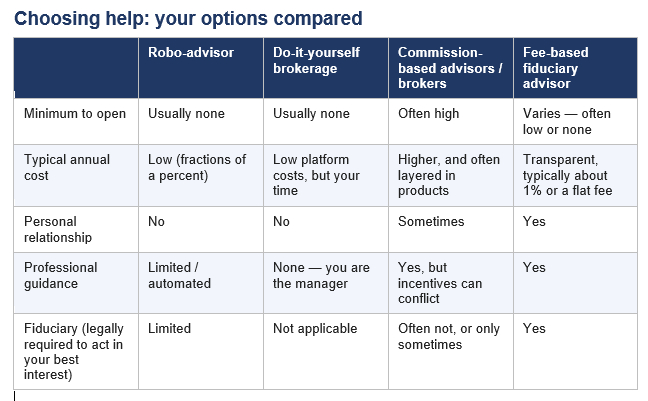
Choosing help: youroptions compared

How IPM Advisory can help
IPM Advisory is a fiduciary advisory firm focused on financial education and planning-first investing. If you would like help applying the ideas in this article to your own situation, schedule a complimentary introductory meeting through our website.

