
The Real Price of Leveraged ETFs
A 4% index decline is unpleasant. What happens to daily-reset leveraged products in the same session is something else entirely — and it exposes why these instruments are so dangerous for long-term savers.
On a single bad day, 2x and 3x leveraged funds can lose a fifth to a third of their value at once. The illustration below — representative products in one volatile session— shows the pattern:
Illustrative: how leveraged products can move in a singlevolatile session (representative examples).
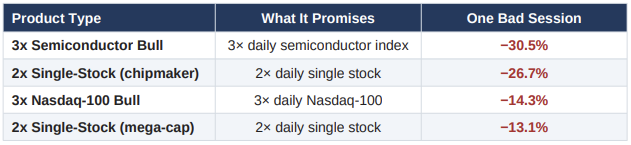
One Day Can Erase Weeks of Gains
A holder up 45% over three weeks can be back to a small single-digit gain after one session. And here’s the question no one can answer: how would you have known to exit the day before? These selloffs are often triggered by good economic news. Short-term risk is invisible until the moment it isn’t — and with daily leverage, that moment can be unsurvivable. Three more sessions like that and a3x fund is down roughly two-thirds; a few more, and most of the money is gone. There is no recovering from zero.
The Math Is Rigged Against the Long-Term Holder
Daily-reset leverage does not deliver 2x or 3x an index’s return over time — it bleeds value on every round-trip the market makes. Regulators documented the definitive case years ago: over one stretch, a sector index rose about8%, yet the 3x bull ETF lost 53% and the 3x bear ETF lost 90%. Both directions lost money while the index went up. The decay compounds quietly, every single day.
What’s changed since then makes it worse. Older leveraged funds sat on diversified sector indexes holding dozens of stocks. Today’s products strap 2x or 3x onto a single company — one earnings report, one guidance cut, one bad session. As Warren Buffett famously called derivatives, these are “financial weapons of mass destruction,” repackaged into one-click products for retail investors.
Regulators have warned about this since 2009: daily-reset leveraged and inverse ETFs are generally unsuitable for retail investors who hold them longer than a single trading session, especially in volatile markets. That isn’t fine print —it’s the product’s design.
Leverage is the only force in markets that can turn a correct view into a total loss.
If You Hold These Products Today
1. Decide which you are: a day trader or an investor. These are day-trading instruments, by design.
2. Size them as money you can afford to lose entirely. A position that can fall 30% on good news has no place at the core of a family’s wealth.
3. Never “average down” on a daily-reset product. The math that rewards patience in a stock works against you here —decay compounds with every volatile day you hold.
Discipline Is the Product
There’s a better way to own the future of technology: unleveraged, deliberately sized, and globally diversified — investing in AI and advanced semiconductors for what they’ll build over decades, not next week’s move. Consider that decades of research on the disposition effect show investors are about 50% more likely to sell a winner than a loser — and the winners they sell tend to beat the losers they keep in the following year. Fortunes are made by staying invested, not by trading in and out feeling clever about small profits.
If a single day can take 20–30% of a position, it isn’t investing — it’s gambling that feels safe inside a brokerage account. If leveraged products have shaken your portfolio or your peace of mind, it’s worth a conversation about a disciplined alternative.

