
Retirement Planning: How to Turn Your Biggest Goal Into an Achievable Plan
Retirement planning is often the granddaddy of financial goals — whether you measure by time horizon or the sheer size of the nest egg needed. Yet many people are woefully unprepared, and with Social Security’s long-term funding in question, the stakes are high.
Consider the gap: median retirement balances sit near $87,000 across all ages, and around $200,000 for those over 65. Using the 4% rule, $200,000 generates only about $8,000 a year in sustainable withdrawals — far short of the $1.5–2 million many say they need for a comfortable retirement. Here’s how to flip the script.
Why Plan? Find Your “Why”
“Retirement” might be reason enough, but digging deeper lights a fire under you. Picture what you don’t want: grinding away in your 70s, or being forced to work when your body says “nope.” Your “why” is your North Star — it keeps you saving and investing year after year. Write it down, revisit it, let it fuel you.
When & Where to Start
The “when” is simple: as early as possible, ideally when you start earning. Time is your greatest ally. Starting in your 20s or 30s gives you a massive edge, yet many delay or never begin because of low income, confusion, or lack of an employer plan. First stop: check whether your employer offers a 401(k) or similar plan — these often include a match, which is free money you shouldn’t leave on the table. No plan? Open an IRA on your own (Traditional, Roth, or a mix). Beyond that, a taxable brokerage account has no contribution limits at all.
The Power of Time
Time isn’t just money — it’s a money multiplier. The longer you invest, the more your savings compound. A modest, consistent habit started early can outgrow a much larger effort started late. The table below illustrates the difference, assuming an 8% average annual return over 40 years.
* Illustrative growth over 40 years at an assumed 8% average annual return.
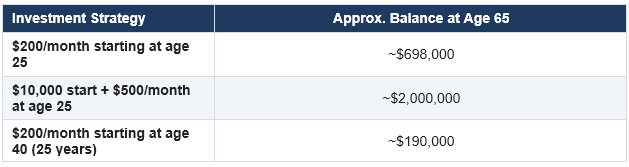
The lesson is stark: the same $200 a month grows to nearly $700,000 starting at 25, but only about $190,000 starting at 40. Start early, stay steady, and let compounding work.
Tax Efficiency: Your Secret Weapon
Retirement accounts come with powerful tax perks. Traditional 401(k)s, 403(b)s, and IRAs give you a deduction now; Roth accounts are funded with after-tax dollars but grow and withdraw tax-free later. Both supercharge growth — one by deferring taxes, the other by eliminating them on gains. Pick what fits your situation, but don’t sleep on the advantage.
Mindset for Growth: It’s Not a Checking Account
To harness compounding, you have to stay invested and keep contributing, no matter what life throws at you. Over decades, markets will test your resolve with booms, busts, and everything between. Fear tempts you to sell; greed nudges you to chase. The winning mindset is patient and disciplined: have a plan for the “what ifs,” adjust it only when your life changes, and tune out short-term noise. Only those who stick to the plan reap the long-term gains.
Spending It Wisely: Enjoy the Fruits
When retirement arrives, it’s time to enjoy your work — thoughtfully. Aim to withdraw 4% or less of your balance annually so you don’t run dry, and sequence which accounts you tap to minimize taxes. Many retirees swing too far — overspending recklessly or hoarding out of fear. The sweet spot: use your money to live your best life, spending with intention while savoring the rewards of a lifetime of discipline.

Not sure you’re on track? A retirement plan review can pressure-test your savings rate, account mix, and withdrawal strategy against the retirement you actually want.

