
What To Do With That Old 401(k)
The average person changes jobs about a dozen times in a career — which means most people leave a trail of orphaned retirement accounts behind them. Here are your four options, honestly compared.
First, a quick refresher
A 401(k) is a tax-advantaged retirement account offered by most employers. Contributions flow in automatically through payroll withholding, employers can match some or all of them, and in a traditional 401(k) the earnings grow untaxed until withdrawal. A Roth 401(k) works in reverse: no deduction today, but tax-free withdrawals later. The IRS sets the annual contribution limits, with a catch-up amount for those 50 and older — confirm the current year's figures, as they adjust periodically.
Similar vehicles exist for other workplaces: 403(b) plans for non-profits and public schools, the TSP for federal employees, 457 plans for government and certain non-government employers, traditional and Roth IRAs for anyone with earned income, and traditional pension plans —guaranteed employer-paid retirement income, now largely phasing out.
What happens when you leave a job
The moment you leave, three things change. You can no longer contribute to that plan. The plan may keep charging an administrative fee to hold your assets —typically a flat dollar amount. And any outstanding plan loan generally comes due, usually as a lump sum since there is no paycheck to repay it from; if it is not repaid, it can be taken from your balance, with taxes and penalties applying.
One more wrinkle for small balances: plans are generally allowed to cash out very small accounts automatically when you leave, and to force-roll modest balances into an IRA. Only larger balances are guaranteed the choice of staying put. (The exact dollar thresholds are set by regulation and change over time — confirm current figures.)
Your four options
1. Roll it over into your current employer's plan (if you have one and it accepts rollovers)
2. Roll it over into an IRA
3. Leave it where it is
4. Cash it out
There is no universally “best” option — only what is better for your situation. But the options are not created equal. Let's take them in order of worst first.
Option: cash it out — usually the worst
Ask the plan administrator for a cash withdrawal and you will get a check — a much smaller one than you expect. If you are under 59½, plan on receiving only around 70% of the balance, because a 10% early-withdrawal penalty applies on top of ordinary income tax on the pre-tax money. You also permanently lose the tax-advantaged growth. Is this a good option? Not really.
Option: leave it as is — usually not great
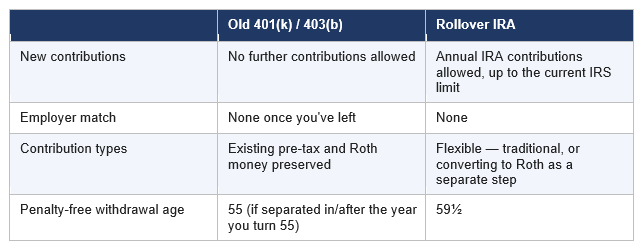
Doing nothing feels safe, but it has real costs: forgotten accounts, ongoing fees, a limited investment menu, and rules that vary company to company. One genuine advantage worth knowing: many plans allow penalty-free withdrawals from age 55 if you separated from service in or after the year you turned 55 — earlier than the 59½ that applies to IRAs. For most people, though, this is a probably not unless that early-access feature matters to you.
Option: roll it into your current employer's plan — often yes
There is no time limit on rolling an old 401(k) into a new one, and rollovers can generally go into a 401(k) or 403(b) if the receiving plan allows it. Two cautions: use a direct rollover (trustee-to-trustee) rather than an indirect one, to avoid withholding, potential tax liability, and penalty risk; and compare the plans first — pay particular attention to the expense ratios of the investment menus to make sure the move is actually an upgrade. If the option exists and the new plan is good, this is most likely yes — it consolidates everything in one place.
Option: roll it into an IRA — often yes
A traditional 401(k) rolls into a traditional IRA; a Roth 401(k) rolls into a Roth IRA. Any conversion between traditional and Roth happens only after the rollover, as a separate, taxable decision. Again: use a direct rollover. The IRA's advantages are a nearly unlimited investment menu and standardized IRS rules; the trade-offs appear in the comparison below. Verdict: most likely yes for many people.

Recap
• Understand your options — all four of them
• Define what is best for your situation — fees, investment menu, consolidation, and access age all factor in
• Take action — an orphaned account left to driftis the one outcome with no upside
• Get help from a fiduciary if you are unsure


How IPM Advisory can help
IPM Advisory is a fiduciary advisory firm focused on financial education and planning-first investing. If you would like help applying the ideas in this article to your own situation, schedule a complimentary introductory meeting through our website.

